
Routespring operations guides
Crew hotel reconciliation: a practical guide for airline finance
Learn how airlines reconcile hotel bookings, folios, invoices and payments, and how Routespring’s ReconAI connects folio retrieval with billing review.
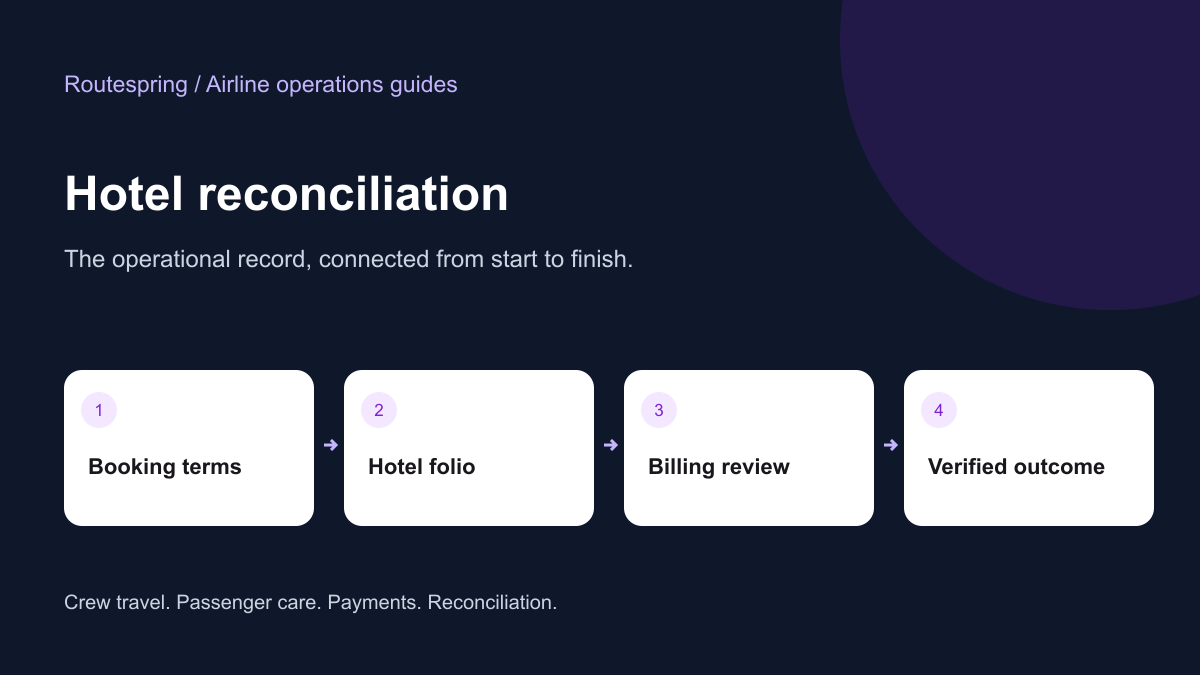
- 1Booking terms
- 2Hotel folio
- 3Billing review
- 4Verified outcome
Crew hotel reconciliation checks whether the stay an airline approved, the hotel’s itemized charges, the supplier invoice and the payment agree. It identifies missing documents, billing differences and credits that still need attention, then follows each issue through resolution.
ReconAI is Routespring’s AI-powered hotel folio retrieval and reconciliation workflow. It coordinates hotel calls and email follow-up, itemizes received charges and flags billing questions against booking and contract information. This gives airline finance and crew travel desks a connected path from a missing folio to a reviewed charge.
The work starts before checkout. Schedule changes, revised rooming lists, early arrivals and late cancellations all affect what should be billed. Keeping those events with the financial record helps the team explain the bill and act on discrepancies.
Understand the four records being compared
A booking records the agreed stay and its terms: property, traveler or rooming reference, dates, rate, inclusions, cancellation conditions and confirmation. It may have several revisions.
A hotel folio is the property’s itemized record for a guest or stay. It can show room charges, taxes, meals, parking, adjustments and payments. Depending on the supplier’s arrangement, it may be combined with other billing documents.
A supplier invoice requests payment or records billed amounts. A consolidated crew invoice can include many stays, room nights, adjustments and references. Its total needs to be checked against the underlying detail.
A payment record shows authorization, charge, refund or settlement activity. Authorization does not prove that a charge settled. A promised refund does not prove the money returned. Retain the relevant reference and state for each.
Establish the matching keys before checkout
Capture a booking ID, supplier confirmation, property identity, stay window, crew or group reference, approved currency, rate basis and payment reference where available. Include the contract version or dated terms supporting the price.
Names alone are weak matching keys. A name can be misspelled, repeated or formatted differently across systems. A consolidated invoice may omit the traveler altogether. Use multiple consistent anchors and route uncertain matches for review.
Store revisions as changes to the same operational story. If a three-night stay becomes two nights, finance needs the original request, the amendment time and the supplier’s response. A final two-night itinerary does not explain whether the third night remained chargeable.
Retrieve and check the supplier document
Missing folios create work before matching can begin. The desk needs to know which document is missing, which hotel to contact, when it last followed up and what was received. Several people chasing the same hotel can create conflicting requests and duplicate attachments.
ReconAI coordinates four specialist agents. CompilerAI organizes the work, VoiceAI contacts hotels, EmailAI handles incoming documents and follow-ups, and ExpenseAI itemizes charges. Their shared workflow connects the supplier document to the stay and gives finance the detail needed for review.
Check readability, dates, currency, completeness and whether the document is a duplicate or replacement. An attachment arriving in an inbox should not automatically mark the stay reconciled.
Compare charges with the terms that applied
Review room-night quantity, rate, tax treatment, contracted inclusions and any amendment or cancellation charge. Make sure the comparison uses the correct price basis. A rate excluding tax cannot be directly compared with a total that includes tax without separating the components.
Contract amendments matter. A seasonal rate or breakfast inclusion may apply only to certain dates, room categories or traveler groups. The system should preserve the source term and the reason a charge was flagged, rather than simply labeling an unusual line an error.
AI extraction can help read inconsistent descriptions and formats. Unclear lines, missing pages and conflicting evidence should remain visible as exceptions. A confident-looking category is not a substitute for the source document.
Worked example: an included breakfast charged separately
Consider a fictional two-night stay approved at $120 per night before applicable taxes, with breakfast included. The folio lists two room nights at $120, taxes separately and an $18 breakfast charge. The booking record and contract support the included breakfast.
The review flags the $18 as a possible inclusion discrepancy. The case contains the folio line, booking reference and applicable term. A reviewer checks whether the charge relates to the covered breakfast or an additional purchase. If the hotel agrees it was billed incorrectly, finance requests a corrected folio or credit.
The status then follows the evidence: discrepancy identified, reviewed, correction requested, supplier response received and credit or corrected billing verified. Until that final evidence exists, the $18 is potential recovery. It is not cash recovered.
If the hotel rejects the request with evidence that the charge covered an extra guest, the case may close as valid billing. A useful reconciliation process records this outcome too, so future reviews improve.
Separate folio reconciliation from invoice audit
Folio reconciliation focuses on the itemized record of a stay and its relationship to the booking, contract and payment. Crew hotel invoice audit often works across a larger billing population: duplicate invoice lines, unsupported room nights, wrong rates, cancellations and credits missing from a statement.
Both workflows need consistent identifiers, but they answer different questions. A correctly itemized folio can still appear twice on a monthly invoice. A monthly invoice total can agree with a payment while containing an incorrect individual charge.
ReconAI connects the per-stay document workflow, while Routespring’s crew hotel invoice audit offering addresses billing across stays and invoices. Together, these workflows help finance examine both the detail of a stay and the larger supplier account.
Create a finance handoff that supports review
An export should state the booking and supplier references, document references, approved and billed amounts, currency, categorized variance, current decision, owner and supporting evidence. Include the actual accounting treatment agreed with the finance team.
Define how unresolved items move into month-end review. Missing folios, disputed charges and credits awaiting settlement represent different situations. Their treatment depends on the airline’s accounting policies and finance decisions.
Routespring connects the operational booking record with folio retrieval, billing review and finance reporting. The result is a clearer path from a completed stay to a reviewed charge, with the supporting records available when a question needs attention.
Measure accuracy and recovery separately
Useful measures include folio receipt coverage for completed stays, unresolved exception value, aging by reason, duplicate-document rate, reviewed matching accuracy and supplier credit realization. Define the reporting cutoff and whether open items are counted by stay, folio, invoice or line item.
Report false flags alongside missed discrepancies using reviewed examples. A process that generates many disputes can increase workload even if it finds some errors. Track human review time and the reasons work returns to the queue.
Frequently asked questions
What is a hotel folio?
A hotel folio is the property’s itemized record for a guest or stay. It can include room charges, taxes, meals, parking, adjustments and payments. Finance uses it with the booking and agreed terms to review the bill.
What is ReconAI?
ReconAI is Routespring’s AI-powered hotel folio retrieval and reconciliation workflow. CompilerAI organizes the work, VoiceAI contacts hotels, EmailAI coordinates email and document receipt, and ExpenseAI itemizes charges for review.
How is folio reconciliation different from invoice audit?
Folio reconciliation examines the charges for a stay. Invoice audit also checks the larger supplier bill, including duplicated lines, unsupported room nights and missing credits. A stay can be correctly itemized and still appear twice on an invoice.
What happens when a hotel has not sent the folio?
The retrieval workflow keeps the missing document, booking reference and contact history together. In ReconAI, VoiceAI and EmailAI coordinate hotel follow-up so the received document can move into expense review.
When is an overcharge counted as recovered?
An identified discrepancy is potential recovery. Track it through the supplier decision and verify the correction, credit or refund before reporting realized recovery. This keeps the financial outcome distinct from the amount initially flagged.