
Routespring Logo
Request Demo

Routespring Automation

AI agents for airline finance and operations work.

Measured against your team before they run alone. Paid on results.

We take one workflow your team already runs, with its documents, systems and written rules, and deploy an agent that finishes the routine cases end to end. A person keeps every decision the policy reserves for people. Nothing runs alone until it beats your own team on your own files.

SOC 2 Type II ISO/IEC 27001:2022 Built on a live airline operation

Shadow mode · week 4

Team and agent, side by side
FileTeamAgentResult
  • Folio 2231 · Hyatt PlaceRoom, tax, parkingRoom, tax, parkingMatch
  • Folio 2232 · Holiday Inn ExpressRoom, taxRoom, taxMatch
  • Folio 2233 · CourtyardRoom, tax, breakfastRoom, tax, breakfast flagged: includedDispute raised
  • Folio 2234 · Hampton InnRoom, taxUnreadable scanTo a person
  • Folio 2235 · AloftRoom, tax, F&BRoom, tax, F&BMatch

Test set closed · Corrections join it weekly

Architecture

What runs where.

The agent reads from your systems and never writes to them directly. Policy lives in code, judgement in the model, and every result comes back as a batch a person can undo.

01 · Your systems

  • GDS queues and schedule-change messages
  • Hotel folios, invoices and statements
  • Contracts, rate loads and fare rules
  • Trackers, consoles and ERP exports
  • Booking records and rosters

Read only. Nothing here is changed directly.

02 · Agent runtime

Policy in code

Eligibility, limits, authority and the audit trail. Deterministic, versioned, tested.

Model

Reads the evidence, weighs conflicts, applies the written policy, writes down its reasoning.

Test set

Your 50 graded files plus every correction since. Run before each policy change.

Runs in your tenant or ours. ISO/IEC 27001 controls. No training on your data.

03 · What comes back

Batch write-back

Validated rows, stamped with the policy version, one-click undo.

Exception to a person

The facts gathered, the reasoning attached, the decision left to your team.

Error watch

Every row checked for eight weeks, then a sample. Weekly report to the owner.

Four rules

Why agent rollouts stall,
and what we do instead.

The model is rarely the problem. Rollouts stall on four things, and each one has a rule.

Failure 1: No business owner

A named owner on your side

One person who runs the workflow today owns the agent after launch, with the authority to change the policy it follows.

Failure 2: No definition of success

A written definition of correct

Before any build, two of your people grade the same 50 closed files blind. Where they differ is the human baseline and the agent’s miss budget.

Failure 3: No guardrails

Guardrails in code, judgement in the model

Code keeps eligibility, limits, authority and the audit trail. The model reads the evidence, weighs conflicts, applies the written policy and writes down its reasoning.

Failure 4: Change management as an afterthought

Change management from day one

The people whose work changes grade the test set, watch shadow mode and correct the agent. Their corrections become the test set.

Method

How a deployment runs

  1. 1

    Week 1

    Pick the workflow and the owner

    One workflow your team already runs, with its documents, systems and written rules, one owner on your side, and one number that decides whether it worked.

  2. 2

    Weeks 1 to 2

    The 50-file test

    Fifty closed files with known outcomes, graded blind by two of your people. We write the agent without looking at them, run it, and report false positives and false negatives against the human baseline.

  3. 3

    Weeks 3 to 8

    Shadow mode

    About 100 new files run beside your team with no answers given. Your team compares weekly. The test set stays closed while we tune, so the agent is never fitted to it.

  4. 4

    Weeks 9 to 10

    Run alone on the cases it has earned

    The agent finishes the routine cases alone. Every batch is stamped with the policy version and can be undone. Exceptions go to a person with the facts gathered.

  5. 5

    After go-live

    Eight-week error watch

    Every finished case is checked for eight weeks, then a sample. Every correction joins the test set. The error rate is reported to the owner weekly.

W1W3W5W7W9Go-livePick workflow and owner50-file testShadow modeRun alone on earned casesError watchEight weeks of full checks, then a sample
Why this route

Compared with the other three ways to do it.

 An internal teamA consulting firmA weekend prototypeRoutespring Automation
Starts fromA backlog and a hiring planA discovery phaseA demo on sample dataYour 50 closed files
Definition of correctWritten later, if at allWritten in the readoutNoneBefore any build
Measured against peopleRarelySometimesNoAlways, blind
Runs the same deskNoNoNoYes, daily
Paid onHeadcountTimeNothingResults
Pricing

Paid on results.
No platform fee.

The 50-file test

No charge

Send 50 closed files under NDA. Within two weeks you get the agent’s error rate against your own people and, for recovery workflows, the dollars it would have found.

10-week pilot

Fixed fee from $35,000

Covers setup, the 50-file test write-up, shadow mode beside your team and a go or no-go report with the measured numbers.

Production, recovery workflows

20% of dollars recovered

Invoice audit, unused tickets and debit memos. A monthly minimum of $3,000. No platform fee.

Production, processing workflows

$2 to $6 per document

Reconciliation, schedule changes and claims. Priced per file handled, with a monthly minimum of $3,000. No platform fee.

Cancel on 30 days’ notice after the first eight production weeks. Your data is never used to train a model.

Security

The same controls as the platform.

  • SOC 2 Type II audited and ISO/IEC 27001:2022 certified.
  • Your files stay in your tenant or ours; the pilot report names which.
  • No direct writes to your systems of record: batches, stamped with the policy version, that can be undone.
  • Nothing you send is used to train a model.
  • Every decision carries its reasoning and an audit trail.
Security and trust
Who does the work

A team that runs the desk it automates.

Routespring runs crew travel for airlines: hotels, disruptions, payments and the reconciliation that follows. The automation team is the people who built that platform and the operations team that works the desk every day. The method on this page came from automating our own work first.

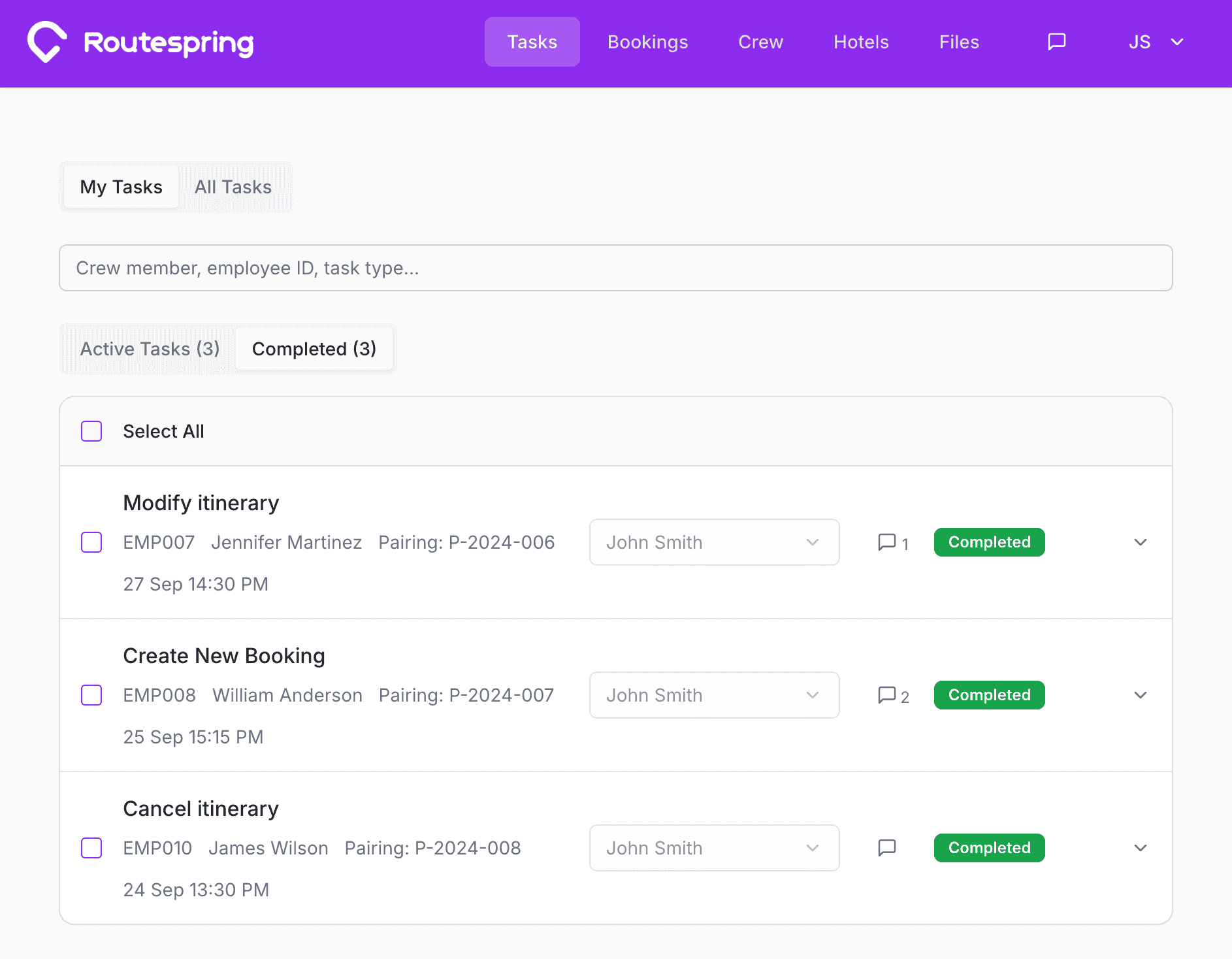
Routespring console task queue listing crew booking tasks with an assignee and a status for each
The Routespring console task queue: where exceptions go, with an owner and a status on each.
Where we said this first

Routespring at OpenAI.

The four rules and the 50-file method were presented to technology executives at an OpenAI event in San Francisco. The same material is on this site, in full, so you can hold us to it.

Events and conversations

October 22, 2026

Presented at an OpenAI event

OpenAI, San Francisco

Tarun Upaday, Routespring’s CEO, presented at an OpenAI event for technology leaders in San Francisco. The session covered why agent rollouts stall in operations: no business owner, no definition of correct, no guardrails, and change management left to the end. The four rules on this page are the answer.

Read the four rules

Questions airlines ask first

Start here

Send us 50 closed files.

Fifty closed cases from the workflow you want to change, under NDA. Within two weeks you get the agent’s error rate against your own team and, for recovery workflows, the dollars it would have found. No charge.

  • NDA first
  • Two weeks
  • The report is yours